Showing posts with label Wargames for children. Show all posts

Friday, 14 April 2017

Games to try over the next few (many?) months

Have not had a chance to play to many games with the boy recently (what with taking him to cricket nets, and football and gymnastics for the girl etc etc). I have however plotted which games I am going to try on him on the coming months. These are, in not particular order but broken down by period.


WW2

Am going to try him very soon with the airfix WW2 game as it seems ideally suited to my purpose, simple game, easy to set up, quick to play. Then thought I would try Rapid Fire. This is the most developed of the 'old fashioned' WW2 games. No 3C complexity, the figures / models act as toy soldiers / model tanks rather than as a representation of a simulated unit with lots of abstractions, seems ideal for a child's thought processes. Then I thought I might try him on Blitzkrieg Commander - mainly as it is a game that I enjoy. Also, it introduces complexity in command - but not to much. Its throw dice below a certain number to get to do stuff, with the number getting smaller each time is fairly intuitive. The combat resolution is fairly straight forward as well.

Ancients 

Building on the success of the One Hour Wargames games DBA seems the obvious next step. Twice the amount of maneuver units, with simple command and control rules and some added complexity in combat resolution. A step forward from OHW and worth digging out my old V2 set. Who knows, may inspire me to by the V3 set. If he can deal with DBA I can then try Art de la Guerre rules. My  ancient rules of choice at the moment and very firmly a DB inspired set. These may be a step to far at the moment but lets see how he gets on with DBA and then have another look.

Dark Ages

Am going to give him a go at SAGA at some point. This could go either way, the battle board may just overwhelm him and leave him confused. Or he may get drawn into trying to figure it out in that slightly obsessive fashion that children can summon up for a topic and end up kicking my arse all around the 11th century - a suck it and see thing I think.

Air Combat

Wings of Glory just seems like it works for children so has to be tried. Am also going to try X wing as well. This is because, well, Star Wars and he is a child so that obviously works. Will also be interesting to compare it to WoG - which so obviously inspired it and see which set works better.

Horse and Musket 

Was going to try playing Charge! as the basic game seems like an excellent starting point for the era and I really do feel that I should play the Blasthof Bridge Scenario at least once in my lifetime as an homage to the giants whose shoulders we all stand on. If that works well, then there are the advanced rules to naturally advance onto. Am considering expanding this out into developing an Imaginations campaign together with the boy - might be a nice project for the years. I was thinking of using the HaT SYW figures as the basis for the armies but can't seem to find them for sale - can anyone confirm if they are out of production or not?

Naval Games

As I play em thought I might as well try em with the boy. For the ironclads will probably use the set written by a club member - these are a little more crunchy than may be advisable for an introductory set. Can anyone recommend a 'starter' set of rules for ironclads? Must cover more than just the ACW mind. For WW2 was thinking of giving GQ3 a go - as they are my set of choice. They can be a little complex but the game is designed well so for shooting all you have to do is look at one table, so it might be doable. Again, any recommendations for a good 'intro' set?

Fantasy

The boy is into Lord of the Rings so fantasy is probably in order. Have got a copy of the LoTR Strategy Tactical Skirmish FIghty Battle Game or whatever they call it. I do remember hearing very good things about it as a set of rules though - which is probably why I got a copy, never got around to playing them mind, now is my chance it seems. Have also acquired a Dungeon Saga from Mantic games - it seems a well thought out relativly simple dungeon crawl game so seems in order to play with the boy. If Warhammer was still Warhammer I might have tried him on that but what with the new Age of Sigmar, not sure I can be bothered to learn new names for Elves and Dwarves and such. Mind you, free rules are a good price pointto try out I suppose. Are there any other rules worth trying out?

Sci Fi

This is easy to sum up with 'Space Hulk'. I brought a set a few years ago when GW did their 'one off, never to be repeated, last chance to buy, limited edition, you will not see its like again' release. This was done on a whim powered by happy memories of playing Space Hulk for many an hour a long time ago. I was in no way disappointed, a well produced high quality game that retained the original simplicity. Have not played it that much mind - maybe time to crack it out. If the boy enjoys it I may then summon up the energy to give 40k a go, or I may not........

Gladiators

Do not own any figures, or know anything about rules, but well, Gladiators are cool and the boy has already read books about them. Any recommendations for rules and figures? Figure wise am looking more for cheap and sturdy rather than exquisite and expensive as well, young hands......

Cowboys

Again, do not own any rules or figures at the moment. However, seems like a fun period for a child. I did consider the fact that cowboys are just not a thing for children anymore - at least round my neck of the woods. However, this just means that I get to watch some cool cowboy films with my children and then play the games - whats not to love about that? I hear good things about Dead Mans Hand as a simple and fast set of rules - would they be suitable? Any other recommendations?

Pirates

Still most definitely a thing for children (and adults come to that). Again, no idea on rules or figures - any recommendations?


The above list seems like enough to keep us going for a year (or two). But I am still open to recommendations. Am especially interested in recommendations for simple boardgames like the airfix one mentioned for WW2. Something simple, cheap(ish) and good to go right out of the box is what i am looking for at the moment. 


Sunday, 2 April 2017

One Hour Wargames Ancients Final Review


     So, would I recommend playing these rules with a child? Are they child friendly? Easy to learn? Will they hold both adult and child's attention? Ok, to go back to my original criteria that I said I was going to judge these rules by. What were the criteria again?


1. Does the boy enjoy playing?
2.  Is enough thought required to make the game worth playing on a (semi) regular basis?
3.Does the game give an impression of being a representation of a battle of the period it is claiming to represent rather than just a generic game (however interesting that game might be)?
4.  Does the game meet my arbitrary, whimsical, undefined and changing ideas of what I want from a game at this moment if time?


     Well, the first question is easy to answer - as outlined in the boys review, he loved it. The second question is a longer answer. As previously discussed in my comments in the boys review, it seems that only after a few games he was picking up the tactics and how to play so I am not sure how long they would retain his attention. This may be that I need to try some more of the 'interesting' scenarios, as these may present ongoing challenges. When he was the attacker in the unbalanced defender scenario however he seemed to crack that one pretty quick.


     The question about does it gave an impression of a representation of a battle, I would still give this largely a thumbs up. OK, all wargames take alot of willing suspension of disbelief, as does this one. But it does deliver sweeping flanking attacks, grinding melees between heavy infantry, nip and tuck between lighter forces. The narrative in every game I played seemed to fit more or less into an idea of a battle. This started to break down when it was 'take a turn for a charge to sweep away an enemy unit' but overall it all seemed to hang together remarkably well for such a simple to learn game. 


     As for the final question about does it meet my demands from a game - which is about teaching a child to play and spending time with my children. The answer would be yes it has but would probably run into diminishing returns. 

    Which leads us into (after many posts and a surprising large amount of months) the big question

   Would I recommend this set of rules for playing with children?


     Yes, absolutely I would, with a few caveats.

     It is an excellent set of rules to start off playing with a child - as I say my boy is seven and he had no dificulties picking up the rules and they gave fun games. So, if you are looking for a first game to play with a child, I would recommend One Hour Wargames - Ancient Rules. Simple rules concepts and does not require much kit so easy to set up. The set up I used took almost no effort and the boy loved it. I could have played with 15mm figures on a one base equals one unit on a table less than half the size and he would have also enjoyed it. Me and the boy had alot of fun playing  the games - what more do you want?

     The caveat is this - you will probably want to look to move on fairly quickly to maintain interest. This could be in a few ways. One way to develop the game with your kid would be to start discussing adding additions rules to make the basic set your own. This has the advantage of requiring critical thought from your child - which if you are a concerned parent looking to develop your child's mental faculties would be great. You could also push this into developing  a campaign as well. As a set of rules they would work well for developing an imagination campaign - requiring imagination and reasoning from your child. This could form the basis of years of toy soldier playing with your child, an idea that I have considered. However, that would be a quite different blog - as this blog is about reviewing different rules for playing with children I will instead look to move on in a different manner. Namely, trying different rules and different periods. Will be posting soon what rules I will be looking at next. 

      Final recommendation - perfect first set of 'big battle' rules for children that have never played any wargames before. Can be used to introduce the hobby in general before moving onto other rulesets or as a basis to develop your own ideas or a campaign.  


Tuesday, 31 January 2017

One Hour Wargames Ancients - The final game of the campaign!

The final game in the campaign, lets go for an interesting scenario - Surprise attack, Scenario Eleven in the book. One army starts with only a couple of units in a decent defensive position and faces the full might of the enemy whilst waiting for the rest of the army to show up. My army is rolled for and again I get three heavy foot, one skirmishers and two mounted. I choose to start with two of the heavy foot on the table between a wood and lake.


 The boys army storms on - three heavy foot making a beeline for my defending troops, the light foot heading for the wood, with a chariot unit supported by a heavy foot unit pushing around the lake. Text book really showing that he is learning how to do this.


I get a choice of either pulling my troops back towards the other flank or staying with firm flanks and toughing it out and hope for the support to come up and save me. Standing firm it is, the opposition continue to sweep into position.

And in they smash frontally with scary things looking like they are happening to the front and rear. Game over before the rest of my army have even turned up surely?

But no! In the nick of time the first wave of reinforcements turn up! I chose to bring on a light foot and chariot unit for their speed to get into position to support.

Which mean the forces threatening the flank and rear of my main line are diverted instead into equal odds fights. Could we pull this out of the bag yet?

Oh yes, I had forgotten about you. I wonder what it is you are about to do?

Ah yes, this is not to much of a surprise - and what pray tell will be the outcome of this devastating flank charge?

Ah, not a surprise there then. On top of that one of my heavy foot have manage to lose  there straight up frontal fights against the bad guys. The two light foot are managing to have their traditional low damage ongoing fight without effecting the rest of the battle that much.

Forward his chariot sweep into the rear of my other foot unit. Anyone want to guess what happens next?

Boom! His free heavy foot units look to from a line against the rest of my army that is soon expected.

Alright guys! We are here! Time to get the party started. Oh, where is everyone? Ah well, we need to do the best we can. I target his most beat up heavy foot unit to take it out.

Which is duly done. However the rest of his troops swing round.....

And in a few turns.....

The inevitable happens......

And I get chomped unit by unit.

My war donkey chariots score a brief victory!

Until they to are gone.

And that is game and campaign over.  3 - 1 to the bright seven year old against his handsome and debonair father.

Comments on this game?

Well, it seems that the side that was being played by the boy, all they had to do was reach a level of basic competence and they would force a win. Have to say the boy made all the correct decisions and got his due rewards. The scenario may seem a bit unbalanced though. Anything I could have done better? Well, instead of standing and fighting on the deployment line if I had pulled my line back, pivoting a flank on the woods to delay contact and protecting a flank against his heavier troops, this could have brought time for the help to arrive. I also notice in rereading the scenario, his army should have all come on at the road and moved their first turn from there, which would have slowed down the fight by a turn or two, giving me more of a chance. So, if we had set up correctly and I had played better then I may have had a chance of winning. Seems fair to me.

Don't want to take anything away from the boy though, he played a good game and got the win his tactics in the situation he was given deserved.

That is the five games that I set myself to play before writing a fully considered review of  the game. That full review is to follow shortly.

Saturday, 7 January 2017

Is playing wargames a positive thing for children?

In the course of thinking about writing this blog, I assumed that playing wargames for children is a positive thing for children to do - and as most people reading this blog will probably be wargamers I assume that most of my audience would agree with me. However, I am aware that not all people may share this assumption, because lets face it, even the term 'wargame', sounds, well, not good. It is possible that someone may come across this blog with a negative view of wargames - and thinks playing them would be a bad thing for children to do.  Because of this I thought I would spend some time considering exactly why I thought playing such games were positive and then laying out my thoughts on the subject. As well as being a parent, I am also a primary school teacher, so thinking about children's development is a professional concern for me, and I run a games club in my school - so thinking about what games children should be playing is something I do as well.

First, a definition of terms - what I actually mean by a 'wargame', as this is a term that has a somewhat precise meaning to those that use it to define their own hobby and a different more mobile meaning to the public in general. I am using the term wargame to mean primarily games played using toy soldiers on a modeled surface to recreate conflicts from history in a competitive but friendly social setting - or 'playing with toy soldiers'. I will also stretch the term to use those games that use cardboard counters on maps to recreate militarily conflicts as well (although there are some that would argue that these are boardgames and therefore different, for the purposes of my arguments they are similar enough). I also include those toy soldier games that represent conflicts from fantasy or sci fi settings. What I am not including are computer games that represent conflict, 'paintball' type games where people run around and actually fire things at each other, or younger children pretending to be soldiers and 'playing war'. I am not excluding these types of 'wargames' because I think they are automatically harmful or because I think my hobby is superior, but because I think they are different enough from 'toy soldier' based games to need to be considered separately.

What are my reasons for saying playing wargames are a positive thing for children?

Wargames are a social activity

With this point I am thinking of comparing tabletop wargames to computer based games. Now, I do not automatically think computer games are bad, they are a popular type of game and I feel that any assumption that computer games are bad is slightly odd - why would playing a digital game be automatically worse than playing a game with pen and paper? They are just different technologies. One particular problem that computer games have though is they tend to encourage solitary play. Itself not a harmful thing within reason, but overall I think it is preferable for children to spend most of their playtime in social activities as it helps them develop social skills. Wargames are very useful at this - as you spend your time with at least one other person sat on the other side of the table. It is also fairly common to have a game with more than one person aside, requiring discussion and agreement of plans. Any activity that requires children to discuss, negotiate and agree joint action  is highly beneficial to a child's social development.

Wargames develop critical thinking skills

This is a big claim but I think a fair one. When playing a wargame it becomes a natural process to analyse a situation systematically and work through possible outcomes before committing to a course of action. At its simplest is the thought process 'if I do x, then y will most probably be the outcome, therefore my opponent may do a, or b, if they do, what may then happen?'. Wargames teach systematic habits of thought because it is effective way to win, so children do it naturally, not because they are told to. This process also requires a child to consider what their opponent may do, to put themselves in their opponents shoes and consider things from their point of view. Anything that can help a child develop empathy can only be a good thing.

It is great for developing maths

Playing wargames is a constant exercise in arithmetic. Wargames rules call for regular use of arithmetic to solve outcomes of combat and movement. Probability is also a constant theme, dice are a near constant in such games and having to work out probability is a standard skill. At its simplest, knowing how likely it is to get say a 5 or 6 on a 6 sided dice. The complexity quickly ramps up with the use if differing dice, calculating the outcomes of an opposed dice throw (my opponent and I both throw a D6, I add a two and he adds a four but he needs to double my score where as a simple win would be useful for me, is this a good risk?). You want your child to use maths not because they have to do homework but because it is useful and fun? Get them playing wargames.

It makes them want to read

Anyone that plays wargames ends up reading more or less voraciously. When playing battles in an era, reading about them is more or less a given. Ah you may say, but it is only reading about battles and war and stuff, which is something I don't want my child to be focused on. Which up to a point is fair enough. However, I would respond with two thoughts. The first is that reading is a habit, so get children reading (almost anything) and reading then becomes something they do and their range of reading will naturally expand. Secondly, although an interest in military history is quite narrow, it leads almost by osmosis to an interest in and learning about political, social and diplomatic history. For example -  if a person was interested in the English Civil War and therefore starting reading about it. This reading could almost not fail to include learning about the causes of the war, the issues involved and the outcomes. So anyone interested in the ECW is going to have a far better knowledge of the development and functioning of the British constitution than the general population. The same could be said in the U.S. with reading about the American Civil War and Revolution. World War 2 is a popular period to wargame - and I think everyone could do with knowing about the lessons, whys and wherefores of that conflict. Not only does wargaming encourage reading but there is a need with wargaming to find out about how units were organised (so as to know what and how many toy soldiers to buy) and what uniforms were worn (so as to know how to paint what you have brought). This is the start and development of research skills - which a child will learn because it is what they are choosing to do with their free time. Do you want to hear your child say things like 'the books I would like for my birthday are.....' or 'can we go to the library this weekend?' Encourage them to play with toy soldiers.

But wargames glorify war!

This I think is the main reason (spoken or unspoken) about being worried about wargames, that it teaches war is a 'good thing'. This is a fear which is one that I can understand. I think it is a bit of a red herring though as it is just not born out by reality. People that play wargames have wildly varying political and world views. Some have a background in the military, most don't. The only common threads is an interest in military history and an enjoyment of playing cerebral competitive games. Without these two factors you would not play games based in military history. As I said in the preceding paragraph this leads to reading about war and the history of war. The thing is, the more you learn about war, the more it is obvious that it is a bad idea. OK, we may all agree that some wars needed to be fought - WW2 being a good example but people that play wargames would not think WW2 was a 'good thing', most would have it down as a necessary evil. Another example, the second Gulf War (the Bush and Blair one), everyone I knew at the time who played wargames, and therefore had a bit of knowledge about warfare and the history of conflict in the middle east, was of the opinion that it was a bad idea that would probably end badly. Knowing how wars tend to play out I think does not on the whole lead to an idealization of war - but a recognition of what war truly is.


OK, so there is probably far to much text on why I think playing wargames can be a positive thing for children. Do you agree with me and think this article is fab? Let me know. Do you disagree with me and think wargaming is a negative past time - I am even more keen to hear your comments.

Friday, 16 December 2016

One Hour Wargames - Back to the Bronze Age

So overall the One Hour Wargames thing seems to be working out. When we started though there were two rules that I decided to miss out. I did not use bowmen as a troop type ( because not very punic wars) but also cutting out a troop type just made things simpler. Also, the rules recommend dicing at random for the composition of your armies. Now, with only six units of a maximum of four types this is not overly complex - but for a start was easier to let the boy play the same army composition.

This also meant a change of armies, wars, indeed epochs.  I needed something that had bows, and well,  I just wanted to give some different toys a run out. So enter the armies of Sumer in all their beginning of history, early bronze age, Uruk World System, I'm the King of Kish, we've got war donkey chariots of death! do you like my Ziggurat? How come we are all speaking Akkadian now?  glory.


For those people interested in such things, the figures you will see in the pictures are nearly all 20mm plastic figures from HaT, although I do believe that some Caesar miniatures have sneaked in as some tribal allies / auxiliaries and a very fine looking job they make of it to.

So new toys and the new rules, on we crack with dicing for army composition. We went with a pitched battle as the scenario as we were introducing some new elements, so it is a good idea to make sure everything else is familiar so you have confidence that the child understands it - stops them getting overwhelmed.  The boy throws and gets four units of heavy foot, one of skirmishers and one of bows. A good solid force with some shooting.


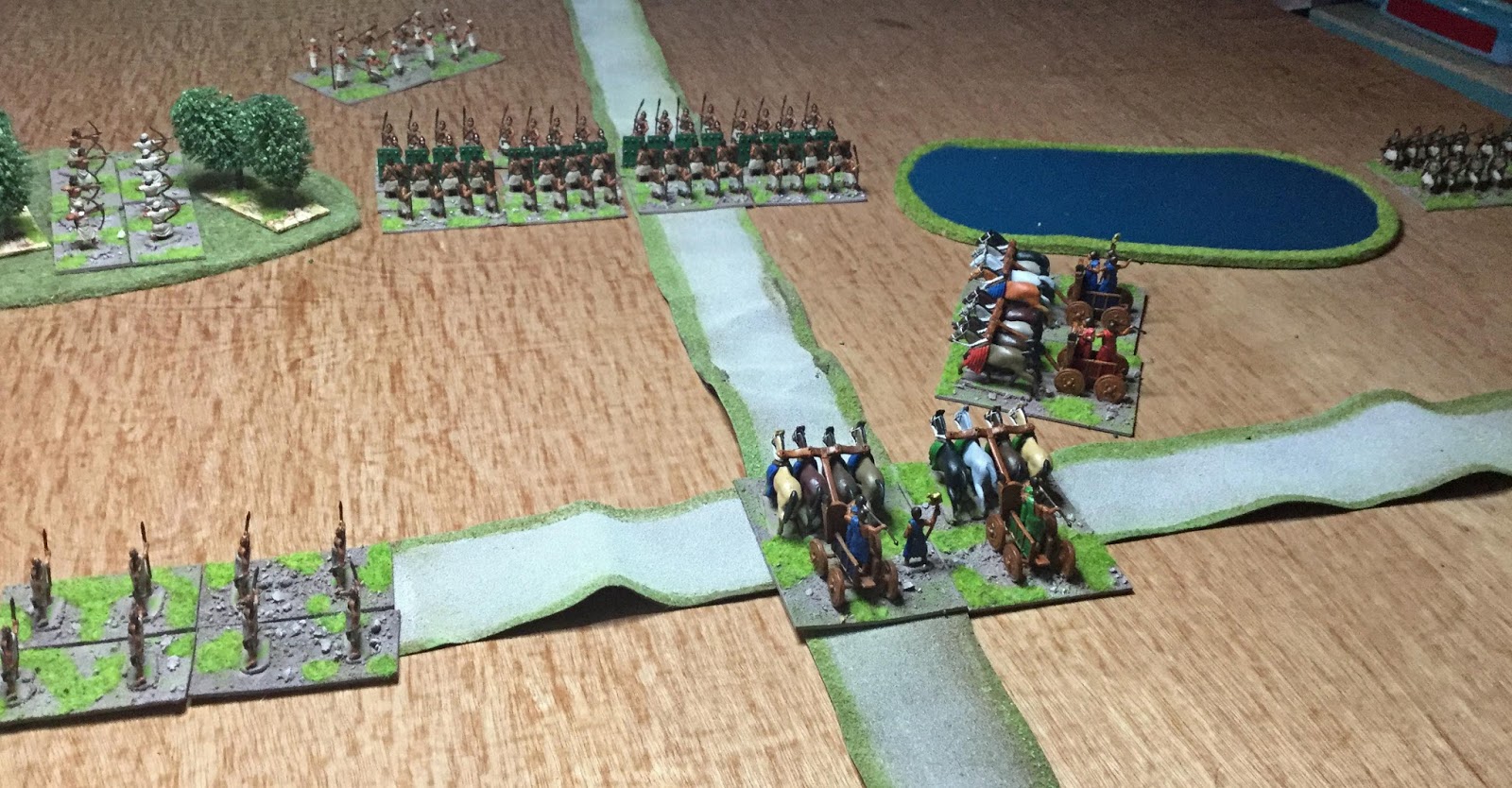
And here they are deployed. In a tight knot in the middle of the deployment zone. This is not to bad of an idea as the movement rates as compared to table size are quite large and it is not to much of a problem to get troops where you want them to go.

For my throw I received an army of three heavy foot, two mounted and one skirmishers - the same as I had been having with the Carthaginians. I am not over convinced by the effectiveness of mounted troops in these rules but at least it had the bonus of familiarity.


My gentlemen deployed. I went for as wide as a deployment as possible with a mounted unit on each flank (fear the war donkeys!).


The two armies facing each other. I put a small lake down as the reason for the fight (when the cities of Sumer had a punch up it was often over the control of an irrigation source). I also included a rather lonely looking field to add a bit of tactical interest.


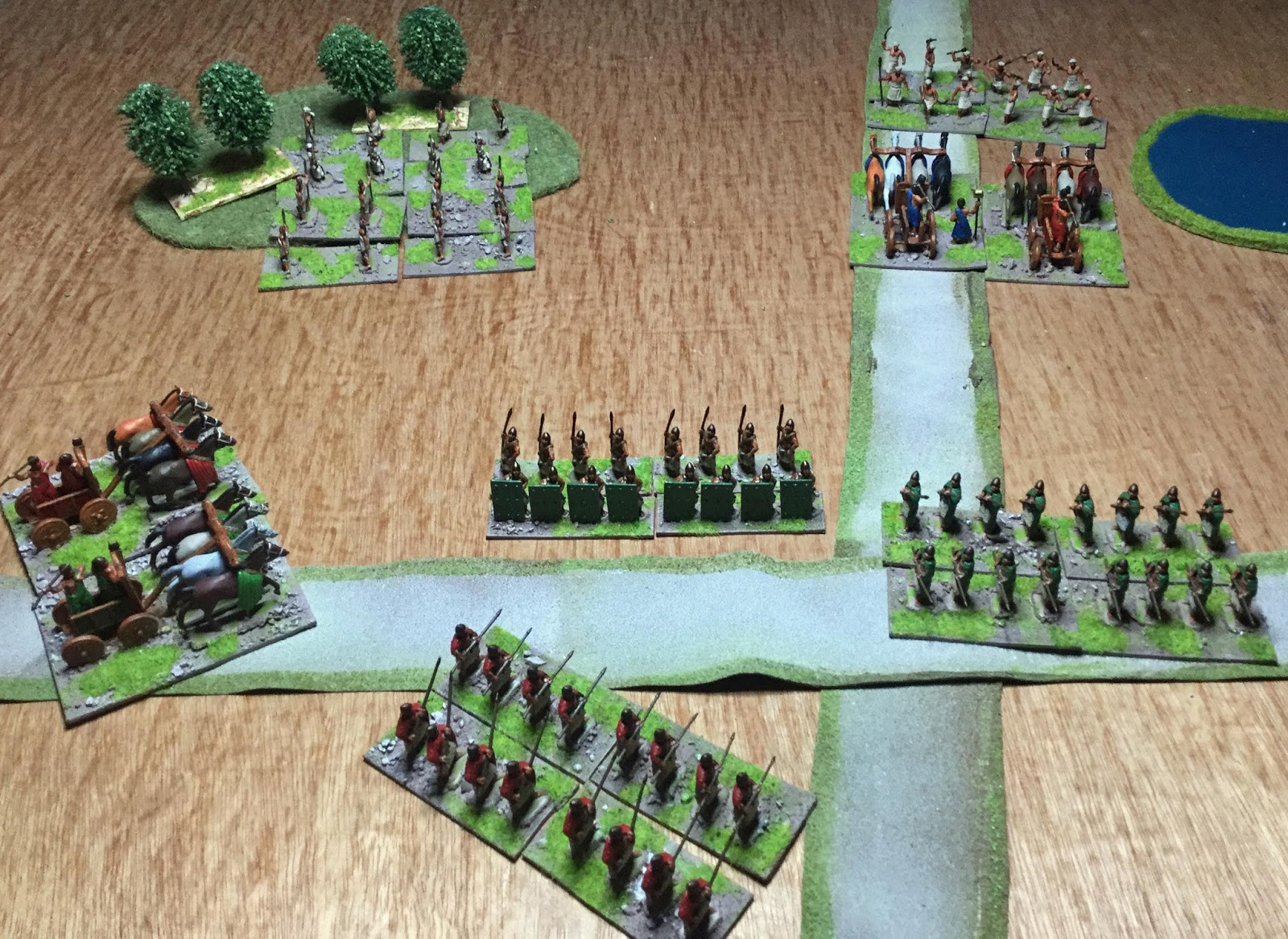
My army throws itself forward. on the left the chariots tuck in behind the foot, which may seem odd. There was not a large amount of room to go on a wide outflanking and if they pushed forward or stayed in line it is possible that the bad guys from the city down the road that was into red might be able to push a unit of heavy foot into them frontally - not good. So they tucked in to await developments. On the right my chariots do push forward looking for a flank or at least diverting enemy resources to a flank.

The boy comes forward and spreads out. A weak point in his line is the bows, that although they can now shoot for a turn or two will get right royally tonked when the fighting is close quarters - win here, delay the chariots getting into action and attack a  flank if so presented, all to the good.


The boys next move. Instead of spreading his line wide he narrows it, pulling the tribesmen into reserve. Usually I would say having a reserve is a good thing but this time I think it is allowing room to pressure his flank with my mounted. The bow are now definitely a target - this will be a painful lesson for the boy but a good one for him to learn.


Or not. The clash of the heavy foot comes. His bows were hanging back. When I move into a position to hit them he responds with a comment of me having 'no chance' of getting at them, pulls them back and puts the tribesmen in the gap. So, he had a plan to get a couple of rounds shooting in before moving his heavy troops in to do the actual fighting. He really has been thinking this through..... and I am guilty of underestimating my opponent. This is however mixed with fatherly pride. The seemingly disembodied hand in this pictures by the way should not be a cause for concern, I can confirm that after the sweat band it is in fact attached to a full child in the normal way.


One consequence of the boys bait and switch is that it has left a hanging flank, which I readily exploit.


Boom! Flank charge. It does mean that my chariots will in turn be hit in the flank but this should already have caused enough disruption to tip the balance of the fight in my favour. 


Meanwhile. on the other flank, the bad guys have shoved a unit of heavy foot down the side of the field and my chariots have steadily given ground. Not to upset by this at the moment though, as it has taken his foot unit out of the fight for several turns as they walk around the side of the board. 


They do keep pushing though....... And the two units of skirmishers have managed to find a suitable venue for their traditional face off, where they can get on with not causing very much damage to each other without being disturbed by the big boys. 


My left hand heavy foot unit has polished off their opponents - due to the earlier flank charge and can now look for another opponent to put the pain on. My chariots from the right flank have now pulled fully back and the boy has a unit of heavy foot loose in my rear. I have presented the boy with a decision though, continue to close against the chariots or interfere with the rear of the main battle line.


He chooses to continue to put pressure on my chariots.


This may be because he knows that my other chariots were going to down to his bows - leading to my now free heavy foot clattering into them. Also, that he was about to win the central heavy foot fight anyhow and did not need the help.


Here his bows have been taken down and his heavy foot have moved to attack them. I have also won the fight against his tribal heavy foot.


An odd looking battle line. His troops in the middle seem doomed. However, they have the next move and therefore the next charge.


Which he uses to take down my now battered unit if heavy foot. His other unit on heavy foot have also eaten my chariots and can start to think about other things.


The other thing being the flank of my sole remaining unit of heavy foot. They charged their opponents in the rear and are well on the way to defeating them.


Which they do - but can you guess what happens next?


Yup, they get hit in the flank and taken down in turn. His skirmishers have also won the even odds dice fest against mine - handing the boy his second victory of the campaign!


Comments on the game - and rules

First thing to say, is that although I may not have brought my A game and was not fully focused on winning, I was not particularly going easy on the boy - I did not let him win and he was making his own decisions, the win was fully deserved. This is a good point in favour of the rules when considering if they are suitable for children, as the boy has now figured out how they work and is able to think through tactics and ideas and apply them.

Another thing in favour of the rules is that they did give some interesting maneuver before the fighting started. Decisions had to be made options weighed, which is as it should be.

Any down side? Well, the closing out of the game was a bit well odd - as units won a fight they queued up to take a turn to deliver a devastating flank / rear attack before suffering one in turn. This seems to be a function of the victory conditions - all units must be killed for the army to break and the lack of morale rules. This means that all units are at full effect and operate with no penalties, no matter what strength they have lost, or how bad their position is until they receive that final hit - then they are gone. This binary situation leads to an thrilling end game - all thrills and spills. However, from my position of questioning 'is this a satisfying end to a game', well no not really.

Still, one more game to go in the campaign before the winner and loser is declared and a full and considered view of the rules is given. The boy has also committed to giving his own full written review at the end of the campaign as well - so you will hear of the rules give a good game for a child from the horses (foals?) mouth.
The most fitting way to leave this game and consider the next one I feel is to consider the boys thoughts and questions about it. Which went something like this

'So, no matter what happens I can't lose the campaign can I dad? If I win the next game I win the campaign?'

'Yup'

'And even if the next game is a draw I win. And even if you win you can't really win.'

'That's right'

'So, you can't beat me then?'

'Well no, but I thought we were playing these games to have  fun and spend time together?'

'Oh no dad, I'm playing to beat you'.......


Thursday, 8 December 2016

One Hour Wargames - an unbalanced scenario


So, on with the testing of the One Hour Wargames Ancient rules for playing with a seven year old.The two games we have played so far have had fairly matching deployment and victory conditions. This I feel has made things simpler and has the added bonus of it being clear that it is 'fair', we are both trying to achieve the same conditions from the same starting point. Throwing in some asymmetric conditions I thought might be a challenge for the boy - lets see how he dealt with it.

The scenario chosen was number 6 'Flank Attack (1)'. I gave the boy a choice of what side he wanted to play after explaining the scenario - to my surprise he chose to be the force being ambushed stating that he would like a challenge - good lad. It also meant that as this was a Carthaginian force ambushing a Roman one it could count as a refight of Lake Trasimene, well sort of, and it's always good to get some history into the games.

Will describe the game briefly, mainly through pictures (being worth 1000 words and all that) to give context and illustrations for my comments before giving those comments on  how we enjoyed it and any problems with the rules. To win the Romans had to get three units of the table edge they are advancing towards - any other result being a victory for Carthage.

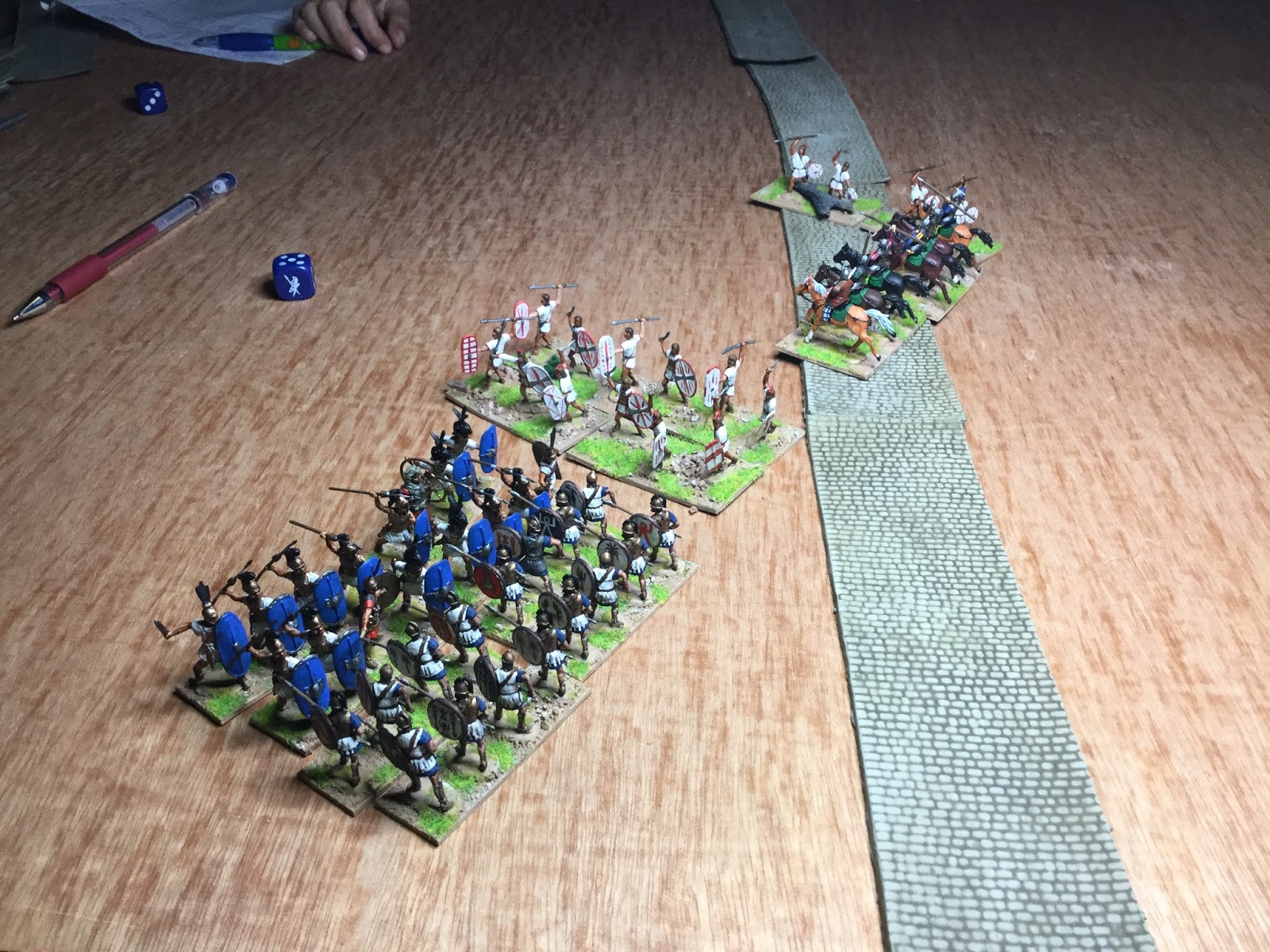
The scenario was that the Roman force was lined up one behind the other down the middle of the road, Carthage could have two units blocking the advance with the rest coming on from the side. As can be seen in the first picture, Carthage had two units of foot playing the role of blocking the Roman advance with another foot closest to the table edge then the more mobile troops further back. The basic plan was to pin the Romans in fights frontally before sweeping in from behind.


The Romans first turn was to advance with their first unit of foot, the velites halt to fire. The cav and the blue legion break right to try and get past the Carthaginians, with the other two units of foot turn to face the ambush and invite the Carthaginian horse to charge in.


The Cav decline the invite and look to sweep around the rear. An attempt to crunch the Triarii is made - a frontal attack with a flank charge being tee'd up. The Gauls in Carthage's service move left to block an easy charge off table.


Rome looks to defend the flank of the Triarii, as a rapid collapse would for them would probably mean game over. It does however mean two of the six Roman units are already committed to fighting in place.  They also look to gang up on the Gauls blocking the advance off table. The last unit is brought back but still facing rearward.


Gauls move to make sure they can not be hit in the flank by anything nasty and the rest of their army closes in.


The Roman velites move of table as it is a unit towards the victory conditions and they can not achieve to much anyhow. The Romans have decided the Gauls have to go if they have any chance of winning so charge the cav in to start that process and move a unit of foot for a flank charge next turn. The rear guard continues to fall back.


The trap is now closing in however. A rear charge sees off the Triarrii, the flank guard legion is in dire straights and the rearguard is engaged by the Numidians. A fight the Numidians can not win on their own but they are looking to pin the rear guard legion in place.


To win the Romans need to get two more units off table - if the Gauls can be dealt with this is possible - in goes the flank charge.


It takes two turns to destroy them however and in that time the Libyan spearman redeploy and get in a rear charge.

The Roman cav ride off for the second unit safe. The rear guard have also destroyed the Numidians but it has taken to long and they are hit in the flank by the Gallic cav.


The writing is on the wall now - two units safe but another needed for the win and the forces of Carthage are all over the remaining Romans.


No way back from this - leading to a Carthaginian victory - with the first victory for the forces of Dadduniam in the campaign!


Did the scenario work?

Yes it did, very simple but gave some interesting decisions to be made. It was complex enough to get the boy thinking but as it was still only six units it was simple enough for him to be able to mentally track. I did give some 'you my want to think about' type comments, which is all ok - as this is what I should be doing anyhow. But all the decisions were taken by him, so all good in the 'quest for a game to play with children' front. The main problem I had with playing this scenario is actually more an issue with the rules - so see below.

Are the rules still holding up?

Over all yes, still giving an enjoyable time for the both of us. The boy was not to unhappy with losing (a potential minefield when playing with children) and was engrossed in the game, with it seemingly close down to the wire. I say seemingly though, due to the IGOUGO (ah, for any non toy soldiery geek initiates this refers to a game style where one side moves all their forces (I go) and then the other does (UGO)). This combined with the simple combat meant that I felt that I could see the way the game would go from quite early on - barring any wild swings of luck. This was not a problem for the boy though and each twist and turn of the game was thrilling. In the future games I am going to have to try and make myself not think things through to much in advance I feel.

The other niggle I had was an echo of my earlier one of defining what a flank charge is. This broadens it out a bit more to look at unit placement and what their movement represents in general. This is illustrated by my early move to bring the Gallic foot out wide. I could have placed them in such a way as to block any possible exit from the table - with not enough room between the unit and the table edge on one side to get past  and on the other to small a gap between the Gauls and my spearmen. As they can only be attacked by one unit frontally this could have caused a severe (and somewhat unfair) roadblock. I decided not to do this. It could be argued a wider table would have negated this problem - true, but I was playing with the table width and deployment zones called for. As, due to there brevity the rules are silent on unusually troop placement I think it is possible that I could (if  I looked) find more ways to take advantage of this in the rules. The rules do seem to depend on the unwritten rule of 'play nicely children', which I am of course using as I am playing with my child. I dread to think of a scenario were the boy sees an advantage in an odd placement - that the rules allow and me trying to persuade him not to do it as it is 'not nice or fair'. Yung children can be very competitive....

Still, again another enjoyable fight and a good time was had by all. The campaign is now one game each and one draw with two games to go and all to play for.


Wednesday, 23 November 2016

So, what am I really looking for in a wargame to play with a child?

I was going to next develop a list of games that I am going to try playing – and ask for recommendations. However, thinking about it I thought that it would make more sense to think about the criteria that would make a game suitable for a child to play so I can then judge if a game might be suitable. I am in no way a game designer so these thoughts are very much of the cuff and from someone that hasn’t given much thought. Any pointers would be more than welcome.  In no particular order here are the things that I think may need to be considered.

1.       The amount of ‘manoeuvre elements’ that a player has to deal with. With the ‘One Hour Wargames’ the boy and I are trying at the moment, although they claim to be a ‘Big Battle’ game, you in fact have at the most 6 units to deal with each turn. Skirmish games are usually considered to be simpler, but if in your skirmish game you have 18 figures running around able to operate independently that is three times as many things to keep track of.
2.       How many different actions each unit can take. If all a unit can move, shot and fight in a turn, that is easy to keep track of. If you are worrying about reloads, overwatch or a morale test this turns into overload for a child quite quickly.
3.       How many rules differing units use / have access to. One Hour Wargames being a useful example again. Every unit uses the same mechanic for fighting – through a dice for a score. You may have to half it for cav or add 2 for heavy foot but this is just a bit of simple arithmetic. Games that have a mechanic that ever unit has access to differing rules can quickly become complex. I love playing Malifaux for instance, but damn, I find it difficult to remember what my units can do, let alone my enemies stuff. Differing rules can be ok if each side has different rules but are the same for that side. So in Space Hulk, Genestealers may play different to the Space Marines, but if you are playing the Genestealers, they all have the same few rules to keep track of – and their player does not have to keep a close track of the Marines rules.
4.       How complex are the command and control rules. Games without any are probably the way to go for children. Or at the least simple ones. DBA’s through a dice and you can move that many elements / groups is probably ok, anything more than that probably a no no.
5.       Are the victory conditions simple, consistent and clear? ‘Kill all the enemy to win’ simple. ‘Have a unit walk of the opposite board edge before turn 10’, probably doable. Any victory conditions that can’t be made clear in one or at most two sentences, probably to much.
6.       Last criteria that I can think of and probably the most important one. How long before stuff happens? I think Peter Pigs pre game in Poor Bloody Infantry is excellently designed to give an exciting asymmetrical game but it is a fair amount of doing stuff before you start shooting each other. Likewise, I prefer games where you can and indeed must manoeuvre for position before the fighting occurs. I feel children however are looking for a game where stuff happens from the get go. Winning may be important to them, but action all the way through is how they want to achieve it.


Any point that I have missed that I should think about. Any advice for things I should consider when looking at games to play? I would be interested in hearing any comments. 

Wednesday, 2 November 2016

One Hour War games - Lets play again


 After the sound thrashing that I received in the first game, we rolled on to play a more interesting scenario, where I was sure my superior tactical acumen would lead to a stunning victory. I chose more or less at random from the early scenarios number 3 - Control the River. The victory conditions were you needed to control both fords at the end of the game (15 turns). Right oh, simple enough. For terrain, again I went with a bare board that I fondly imagine is the colour of fields of Sicily in Summer, or somewhere. A river is added (fairly obviously), with two fords - one marked by the road. I also added a wood for a bit of interest - and because the boy likes having terrain.

My cunning plan - born out of my superior tactical knowledge of course was to throw my cav over the fords and fight the Romans on the opposite side of the river - where they would get butchered. However,  this would mean my heavy foot would get to the fords first. As the defenders at a ford only take half hits, on top of the half hits that heavy foot take this means they could see off all comers.

And here is the plan being put into action, horse galloping up, with my skirmishers in the middle so it can shoot in either direction as needed, one unit of heavy foot to take each ford and one in the middle as a reserve. The boys dastardly Romans are more concentrated. He has also placed his Velites in the wood, where they will be more or less useless. The wargames rule of 'you must stick rough terrain troops in a wood no matter if this is a useful thing to do or not' is followed by far more experienced wargamers than him, so  I can not hold it against him.

Realising that control of the fords is important, the boy throws his cav forward to control one crossing, so I pull my Numidians back to let the Spanish foot storm the ford. On the other side, my Gallic Cav are well on the way to carrying out the 'being butchered' part of the plan but this does allow the foot to take the ford.

 Not content with letting me attack his cav on the ford he throws them forward so his legions can dig in on the ford. It does mean his cav give up the protection of the ford and will get tonked, but all in all a good move. Hmm, my boy does seem to be a fast learner. His Triarii have also walked over their mounted opposition and move up to start the attack on the other flank. He has also realised that sitting in the woods with his sole missile unit is a waste of time and has brought it up to the river where an inconclusive exchange of javelins is taking place with my light foot.

        
A few turns later. My Spanish have attacked the ford to their front and my Gauls have beaten the Triarii so the Italian allied foot are thrown in. At this point, the game degenerated into a dice throwing contest as we ground out casualties on each other.

 The Spanish die so the Libyan Spearman are tee'd up for the fight.

His Italian allies die so a Legion is moved to be thrown in. The boy was also getting the worst of the Javelin exchange so has pulled back from that to save his unit being destroyed - again, a sensible and clear sighted decision.


The game was due to take 15 turns and at that limit (lets call it nightfall) whoever is defending the ford is judged to have held it. So a drawn game.


So, how was it?

As a game, not to great. There were a few moves to try and grab the fords first but most of the game were two static combats with one side having a big advantage on each combat. This may be realistic - as only battle that is funneled into two narrow areas will be a frontal grind but it does not make for an interesting game.

This is partly my fault with the choice of scenarios. Each scenario is supposed to be used with all the sets of rules. Those rules where most (or all) units shoot would have been much more interesting, as you would not need to be in contact to fight. If I had given half a seconds thought to this I would have seen that I should have used another scenario. In my defense I would say that the rules say all scenarios can be used with all rules and I took them at their word. Next game, I will be sure to run a quick mental check to ensure that it will give a suitable game.

Good points? Well, the rules worked well and were easy to follow and gave no results that I would say were odd or incorrect - so that is still a big plus. The boy understood them and could apply them himself, which in the second game of playing them is a good thing for a set of rules that I want to use to play with children. Being so simple it also gave him space to think about tactics, which he did with aplomb. We also both enjoyed the game, it gave a good focus for us spending time together and we got to cheer or curse the dice and enjoy playing together, which is the most important part of the exercise.


 I will also need to try some armies with the ancients rules that use bowmen to give all the unit types a run out which I will do shortly. Am going to go with one more Punic War game first though - 'Flank Attack' as it seems to be a far more suitable scenario for the armies involved - report to be posted soon.